
Pharmacovigilant by Default: Rethinking PSP Architecture
September 16, 2026

Generative AI tools like sales copilots and HCP chatbots now speak on pharma's behalf in real time, bypassing the MLR review process built for static, deterministic content — and in September 2025 the FDA's OPDP issued nearly 100 enforcement letters in a single week using its own AI surveillance tools. This guide covers the three-layer architecture (real-time guardrails, semantic/regulatory agents, platform-native governance) needed to monitor AI outputs continuously instead of relying on the sample-based review that can no longer keep pace.
AI compliance monitoring in pharma operations has two distinct surfaces. The first is the transactional surface: every HCP interaction, every transfer of value, every grant decision and program execution event, continuously read and classified against policy. The second is newer and less governed: what happens when a generative AI system speaks on a pharma company's behalf. A sales copilot drafts a pre-call plan. An HCP chatbot answers a dosage query in real time. Neither waits for MLR review. Neither produces a deterministic output. Both are now enforcement surfaces.
This post covers that second surface. AI output compliance monitoring, the real-time surveillance of what AI systems generate within pharma commercial and medical workflows. It is the specialised sub-layer of Watch: the capability within a compliance intelligence platform that reads AI outputs the same way Watch reads human transactions continuously, in context, with policy citations in the audit log. For the complete six-capability compliance platform framework (Watch, Know, Build, Guide, Run, and Report), see our guide to AI-powered compliance platforms for life sciences.
Zelthy is an AI-native compliance intelligence platform for life sciences, providing 100% transaction coverage across field operations, HCP engagement, PSP workflows, and promotional review, deployed in 4–8 weeks. Trusted by Roche, Bristol-Myers Squibb, AstraZeneca, and Novo Nordisk across 12+ countries, with 75+ pre-built compliance use cases in production.
The pharmaceutical industry is navigating a pivotal transformation driven by two forces colliding: the rapid adoption of Generative AI across commercial and medical workflows, and an increasingly aggressive regulatory enforcement landscape targeting digital communications. As pharmaceutical companies deploy Large Language Models to power sales team co-pilots and HCP-facing chatbots, they confront a structural paradox. The stochastic nature of GenAI, its inherent ability to generate novel, probabilistic responses, conflicts directly with the deterministic rigidity of pharmaceutical compliance, where every claim must be substantiated, every risk disclosed, and every adverse event reported.
This post covers the AI output compliance monitoring landscape, from infrastructure-layer guardrails to agentic compliance systems, and frames where each layer fits within a unified operational compliance platform. The focus is two high-stakes use cases: Sales Team Chatbots (internal tools assisting representatives with pre-call planning and content retrieval) and HCP Chatbots (external interfaces on drug websites providing medical information). Both are Watch layer problems. Both require the same architectural answer: AI reading AI outputs in real time, with policy-grounded audit trails.
The drivers are existential. In September 2025, the FDA's Office of Prescription Drug Promotion issued nearly 100 enforcement letters in a single week, the agency's most aggressive enforcement action in decades, and confirmed it had deployed its own AI tools to surveil promotional content at scale. The enforcement surface is now 100% of AI outputs. The review surface, at most pharma companies, is still a sample (Hall Render, 2025).
The deployment of conversational AI in life sciences represents a fundamental shift in the enterprise risk surface. Traditional digital assets, such as static websites, detail aids, and email templates, are deterministic. They undergo rigorous Medical, Legal, and Regulatory (MLR) review before dissemination. Chatbots and conversational agents, however, are dynamic. They generate responses probabilistically in real time, effectively bypassing the pre-approval containment mechanisms that have defined pharma compliance for decades. This shift necessitates a move from pre-approval review to real-time monitoring.
The FDA's Office of Prescription Drug Promotion (OPDP) is the primary arbiter of truthful and non-misleading promotion in the United States. The integration of AI chatbots introduces a unique liability: hallucination-driven misbranding. If an HCP chatbot on a drug website, driven by an LLM, fabricates a clinical study result or suggests efficacy in an unapproved indication (off-label), the manufacturer is strictly liable for misbranding under the Federal Food, Drug, and Cosmetic Act (FD&C Act).¹
Recent enforcement trends indicate that the FDA is modernizing its oversight capabilities to match the industry's technological adoption. The agency has explicitly committed to leveraging "AI and other tech-enabled tools" to proactively surveil promotional activities, with a specific focus on "AI-generated health content and chatbot interactions".¹ This development creates a technological arms race; regulators are using AI to detect violations, compelling pharmaceutical companies to deploy superior AI compliance monitoring to prevent them.
The FDA's focus has expanded to "closing digital loopholes," explicitly mentioning algorithm-driven targeted advertising and chatbot interactions as areas of renewed scrutiny.² This is not a theoretical risk; in September 2025, the FDA issued a flurry of enforcement letters, signaling a departure from the "overly cautious approach" of previous years and a return to the aggressive enforcement paradigms of the late 1990s.³ The agency's use of AI to scan vast troves of digital content means that the probability of detection for non-compliant chatbot outputs is approaching 100%.
For teams managing submissions and regulatory intelligence across jurisdictions, Zelthy's regulatory operations platform tracks requirement changes across health authorities and automates dossier preparation.
In traditional media, "fair balance" (the presentation of risk information comparable to benefit claims) is structural. A print ad has a "brief summary" page; a TV spot has a rolling "major statement." In a chatbot conversation, fair balance must be temporal and contextual.
If a sales rep's internal chatbot suggests a talking point about efficacy, it must simultaneously surface the relevant safety warnings. If an HCP chatbot answers a query about dosage, it cannot omit contraindications. Compliance monitoring systems for these interfaces must possess Contextual Awareness. They cannot simply scan for keywords; they must evaluate the gestalt of the conversation to ensure that the risk profile is presented with "equal prominence" to the benefit profile.³
The complexity of this task is compounded by the "Clear, Conspicuous, and Neutral" (CCN) standards finalized by the FDA in 2023.¹ A chatbot response that buries risk information in a dense paragraph or a hyperlink may fail the CCN standard. The monitoring AI must assess the readability and prominence of the safety information within the chat stream, ensuring that the "major statement" is not just present, but effectively communicated. The FDA's move to eliminate the "adequate provision loophole"—which previously allowed broadcast ads to reference a website for detailed risks—suggests that chatbots will be held to a standard where safety information must be integral to the interaction, not offloaded to a secondary source.²
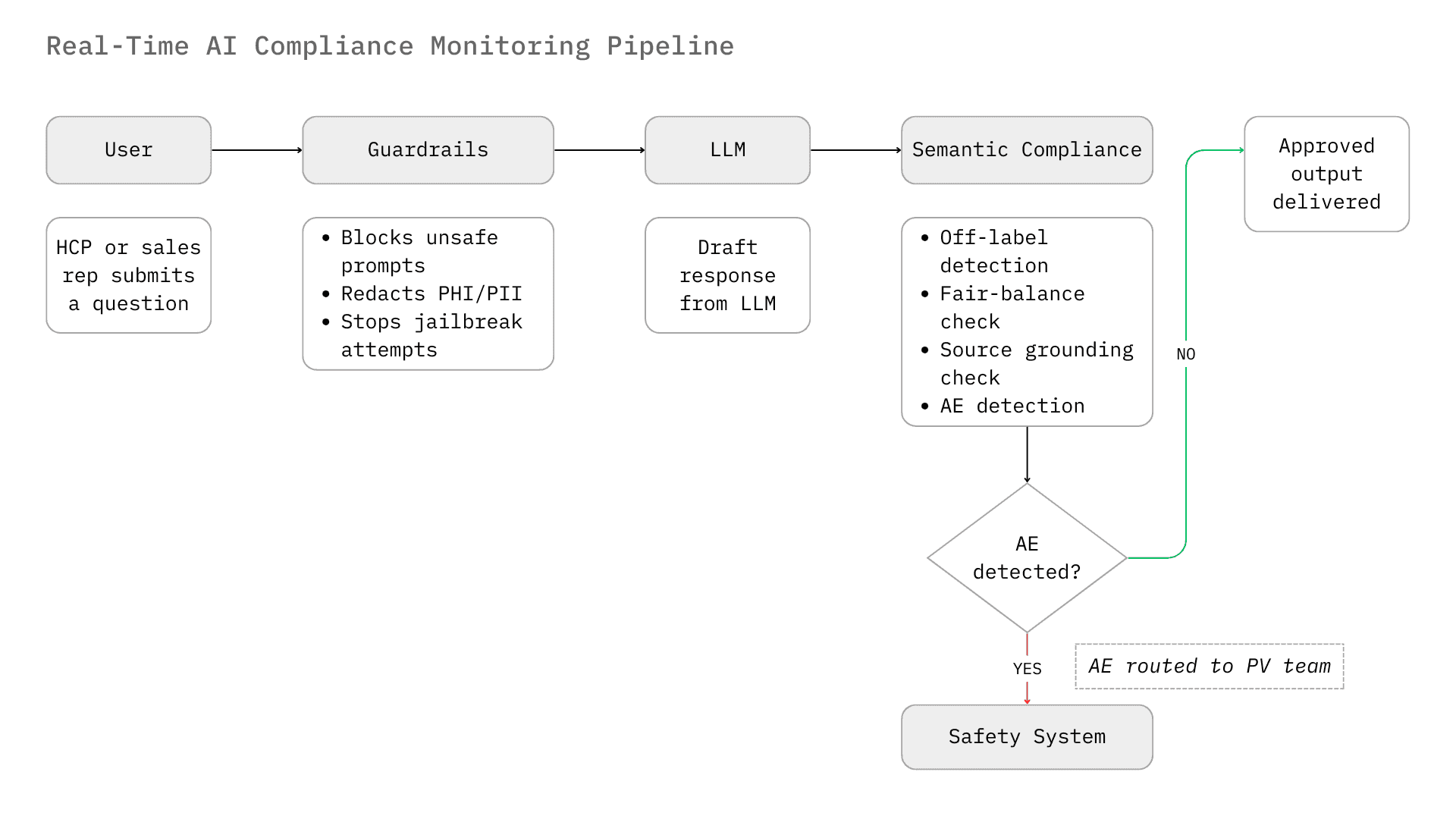
Perhaps the most critical operational risk in pharma AI deployment is the detection of Adverse Events (AEs). Pharmaceutical companies are legally mandated to report AEs to health authorities (FDA, EMA, PMDA) within strict timelines (e.g., 15 days for serious, unexpected events).⁴
Chatbots interacting with HCPs or patients inevitably solicit health data. A patient might type, "I took your drug and felt dizzy." A standard LLM might respond empathetically. A compliant system must recognize "dizziness" as a potential AE, classify it, capture the reporter's details, and route the unstructured text to the safety database (e.g., Argus, ArisG) for processing.⁵
Failure to capture an AE mentioned in a chatbot conversation constitutes a significant compliance violation. The market for AI monitoring in this sector is driven by the need to automate this "intake and triage" process. Manual review of every chat log is economically unfeasible given the volume of interactions. Therefore, companies require AI monitoring solutions with high sensitivity (recall) to ensure that no potential safety signal is missed.⁷ This is distinct from standard "toxicity" monitoring; an AE description is often benign in tone but critical in regulatory weight.
The pharmaceutical industry harbors a profound distrust of "Black Box" AI. A recent survey revealed that 65% of pharma marketers distrust AI for creating regulatory submissions due to concerns over hallucinations and lack of traceability.⁹ This sentiment drives the technical requirements for compliance monitoring systems. They cannot merely be filters; they must be auditable systems of record.
Monitoring systems must provide a "Glass Box" view. It is not enough to block a response; the system must log why it was blocked, citing the specific business rule or regulatory statute. This creates an immutable audit trail necessary for responding to FDA inquiries or Department of Justice (DOJ) investigations.¹⁰ The demand is for "Explainable AI" (XAI) that can justify its decisions—e.g., "Blocked response because it implied efficacy in a pediatric population, which contradicts Section 4.1 of the USPI."
The compliance challenges described here apply across every AI-powered pharma workflow, including patient support. Our analysis of how AI is transforming PSPs in 2026 covers the operational side of this shift.
The market for AI compliance monitoring is not monolithic. It spans from infrastructure-level security (preventing prompt injection) to high-level semantic analysis (detecting off-label intent). We categorize the solutions into three distinct architectural layers that companies are assembling to create a "defense-in-depth" strategy.
This layer operates at the point of inference. It intercepts the user's prompt before it reaches the LLM and intercepts the LLM's response before it reaches the user. It is the first line of defense, focused on security and basic safety.
This is the highest value segment for pharma. These systems run in parallel or post-hoc to analyze the content of the interaction against specific regulatory frameworks (e.g., 21 CFR Part 202, PhRMA Code).
Major life sciences platforms are embedding compliance monitoring directly into their CRMs and content management systems, viewing compliance as a feature rather than a separate product.
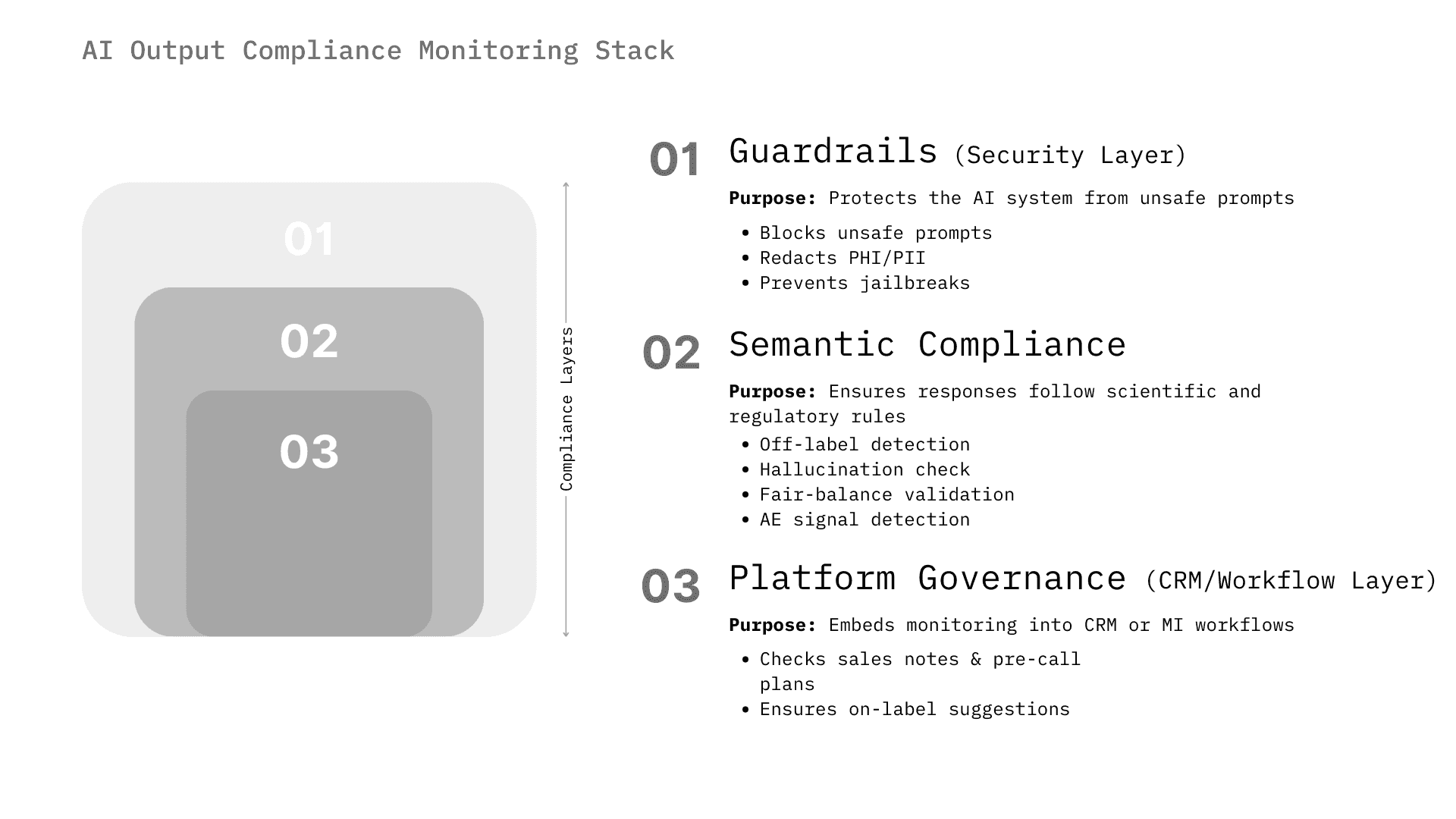
The AI output compliance monitoring ecosystem operates across three architectural layers:
The limitation of assembling these three layers from separate vendors is auditability. Each layer logs in its own system. When an enforcement inquiry arrives, reconstructing the full chain, what was asked, what the LLM generated, what was blocked and why, what was routed to the PV team, across three vendor systems is a significant operational exercise.
A unified Watch layer integrates AI output monitoring within a single governed data architecture, the same system that monitors HCP transactions, field operations, and PSP workflows. Every flagged AI output cites the specific SOP version in the same audit log that holds every other compliance record. The Glass Box standard becomes operationally achievable when monitoring is consolidated, not federated.
Zelthy's compliance platform implements this: Watch agents cover both transactional operational data and AI-generated content, under a single audit architecture and policy corpus.
The three-layer AI architecture described above governs a specific problem: what happens when an LLM generates a response. But AI compliance monitoring in pharma operations extends well beyond chatbot outputs. For most compliance officers, the higher-volume, higher-risk surface is the one that predates generative AI entirely — field force conduct, HCP engagement patterns, PSP transaction flows, and the regulatory changes that should be triggering SOP updates but often aren't, because no system is watching.
This is the operational compliance gap: most pharma companies review 2–5% of transactions. Regulators enforce against 100%.
Closing it requires a different kind of AI monitoring — one that reads every transaction in context, not just the outputs a chatbot produces.
Field force compliance failures rarely come from individual bad actors. They come from patterns; a speaker program whose attendee list has drifted from the original approval, an HCP receiving hospitality across multiple events whose aggregate value crosses a Sunshine Act threshold, a rep whose call notes contain language that signals off-label discussion. Manual sampling catches none of this.
AI compliance monitoring for field operations reads every CRM interaction, every expense entry, every speaker program record continuously, not quarterly. It surfaces anomalies that don't trip any individual rule but are statistically significant: clustering patterns in HCP spend, repeat attendees across promotional events, call note language that deviates from approved messaging. The monitoring layer flags what matters; human reviewers decide what to do about it.
The output is not a larger list of exceptions for compliance teams to work through. It is a smaller, higher-confidence set of genuine risks — because the AI has already dismissed the false positives that sampling-based review either catches incorrectly or misses entirely.
Patient support programs create a distinct compliance surface. A PSP that processes thousands of patient enrollments, benefit verifications, and product dispatches per month is generating continuous transaction data that most compliance functions never review. The risks are real: adverse event signals buried in coordinator call logs, consent lineage gaps that become DPDP or HIPAA exposure, PAP eligibility decisions that don't match documented criteria.
AI monitoring applied to PSP operations does three things that manual review cannot. First, it reads 100% of patient interaction records for adverse event language, not as a downstream PV activity, but as a real-time operational check. Second, it validates consent and eligibility decisions against documented SOPs at the point of processing, not at audit time. Third, it maintains an audit-ready log of every coordinator action and system decision, so inspection preparation is continuous rather than a six-week manual exercise.
A leading global pharma company managing oncology patient assistance across multiple markets reduced onboarding time by 60% and improved therapy adherence by 45% after moving to a platform with AI-native compliance monitoring built into the PSP workflow, not added as a separate governance layer on top of it.
The compliance monitoring problem is not only transactional. It is also temporal. When the OIG issues an advisory, when EFPIA tightens hospitality limits, when FDA clarifies expectations for AI-generated promotional content, a compliance function running on rules engines and manual processes faces a predictable sequence: analyst reads the guidance, maps it mentally to affected programs, opens a change request, routes it through policy review. Six to twelve weeks from publication to updated SOP is typical. In that window, programs are running against outdated policy.
AI regulatory intelligence compresses this from weeks to hours. The model reads the regulatory update, identifies every impacted SOP, policy document, and active program in the company's corpus, and assigns action items to the right owners automatically. The compliance team does not need to discover the gap; they receive a structured impact summary and a draft revision for review.
This is not a monitoring capability in the narrow sense. But it is where AI compliance monitoring for pharma operations has its highest leverage, because the violation that happens in week four of a six-week SOP update cycle is a violation that no guardrail infrastructure would have caught.
Pharmaceutical sales representatives are increasingly supported by AI co-pilots, which are chatbots integrated into CRM systems that help reps plan calls, summarize interactions, and retrieve approved messaging. The primary objective here is Commercial Effectiveness, but the primary constraint is Compliance.
Historically, pharma companies have restricted sales reps from entering free-text notes in CRMs to avoid the risk of recording off-label discussions or unverified claims, which could be discoverable during litigation. Reps were forced to use "drop-down" menus, limiting the richness of data captured.
The AI Solution: AI compliance monitoring is unlocking the "free text" capability.
Market Insight: The market for monitoring sales chatbots is essentially a market for enabling sales intelligence. Compliance monitoring is the "license to operate" for generative AI in the field. Without the ability to monitor and sanitize inputs/outputs in real-time, legal teams will not approve the deployment of GenAI sales assistants.
Sales chatbots often generate "Pre-Call Plans" suggesting what a rep should discuss with a doctor. This "Next Best Action" (NBA) capability is a core driver of sales efficiency.
| Vendor | Solution | Key Compliance Feature |
|---|---|---|
| Veeva Systems | Vault CRM Agents | Free Text Agent: Real-time analysis of notes for prohibited terms; Pre-Call Agent: Ensures suggestions align with approved strategies. [19] |
| Salesforce | Life Sciences Cloud | Einstein Trust Layer: Secure data retrieval, toxicity detection, and "zero retention" of data by the LLM provider. [20] |
| Aktana | Contextual Intelligence | Strategy Orchestration: Aligns AI suggestions with "full context" and compliance rules to prevent off-label prompts. [22] |
| Shaperon | Monitoring AI | Email & Call Log Monitoring: Claims 99% accuracy in risk assessment, reducing manual monitoring workload by 98%. [25] |
HCP chatbots on drug websites (e.g., "Ask Pfizer" or brand-specific sites) serve as automated Medical Science Liaisons. They answer complex clinical queries, a function traditionally handled by call centers. The stakes here are even higher than in sales, as the information is directly clinical.
Unlike sales bots, HCP bots often need to discuss off-label information if it is in response to an unsolicited request (a "safe harbor" in many jurisdictions). However, distinguishing between a compliant "unsolicited request" and a bot-prompted "solicitation" is nuanced.
For HCP chatbots, the ability to recognize an Adverse Event (AE) is non-negotiable.
A compliant HCP chatbot must cite its sources. "Trust but verify" is the operating model.
While commercial compliance focuses on what is said, pharmacovigilance (PV) focuses on what is heard. The market for AI monitoring in PV is driven by the sheer volume of unstructured data generated by chatbots and social listening.
Traditional PV relies on human data entry professionals to read emails, listen to call recordings, and manually code AEs into databases like Argus. This process is slow, expensive, and error-prone.
The "Waldo" study ²⁷ provides empirical evidence that specialized, smaller models (SLMs) are superior to large generative models for compliance monitoring tasks like AE detection.
The market is stratified by the depth of pharmaceutical specialization. We identify four tiers of vendors competing for the compliance monitoring budget.
The AI compliance monitoring market segments into four tiers:
Companies typically assemble a "defense-in-depth" strategy combining solutions across multiple tiers.
| Vendor | Core Focus | AE Detection | Off-Label Guardrails | CRM Integration | Key Differentiator |
|---|---|---|---|---|---|
| Veeva | Commercial/R&D Platform | High (Vault Safety) | High (Vault CRM Agents) | Native | The industry standard; integration with content/data is seamless |
| Sorcero | Medical Affairs | High (Literature Monitoring) | High (Prohibited Intent) | Connector | "Medically-tuned" AI; specifically designed for scientific accuracy |
| Salesforce | Commercial Cloud | Med (Partner Dependent) | High (Einstein Trust Layer) | Native | Einstein Trust Layer provides a robust, generic safety net; heavily customizable |
| Norm.ai | Regulatory Compliance | Med | Very High (Regulatory Agents) | Connector | "Compliance as code"; turns regulations directly into monitoring agents |
| Lakera | AI Security | Low (Requires Tuning) | Low (Focus on Security) | API | Best-in-class defense against prompt injection and security threats |
| WhizAI | Analytics | Med | Med | Connector | Domain-specific analytics bot; keeps commercial teams compliant with data access |
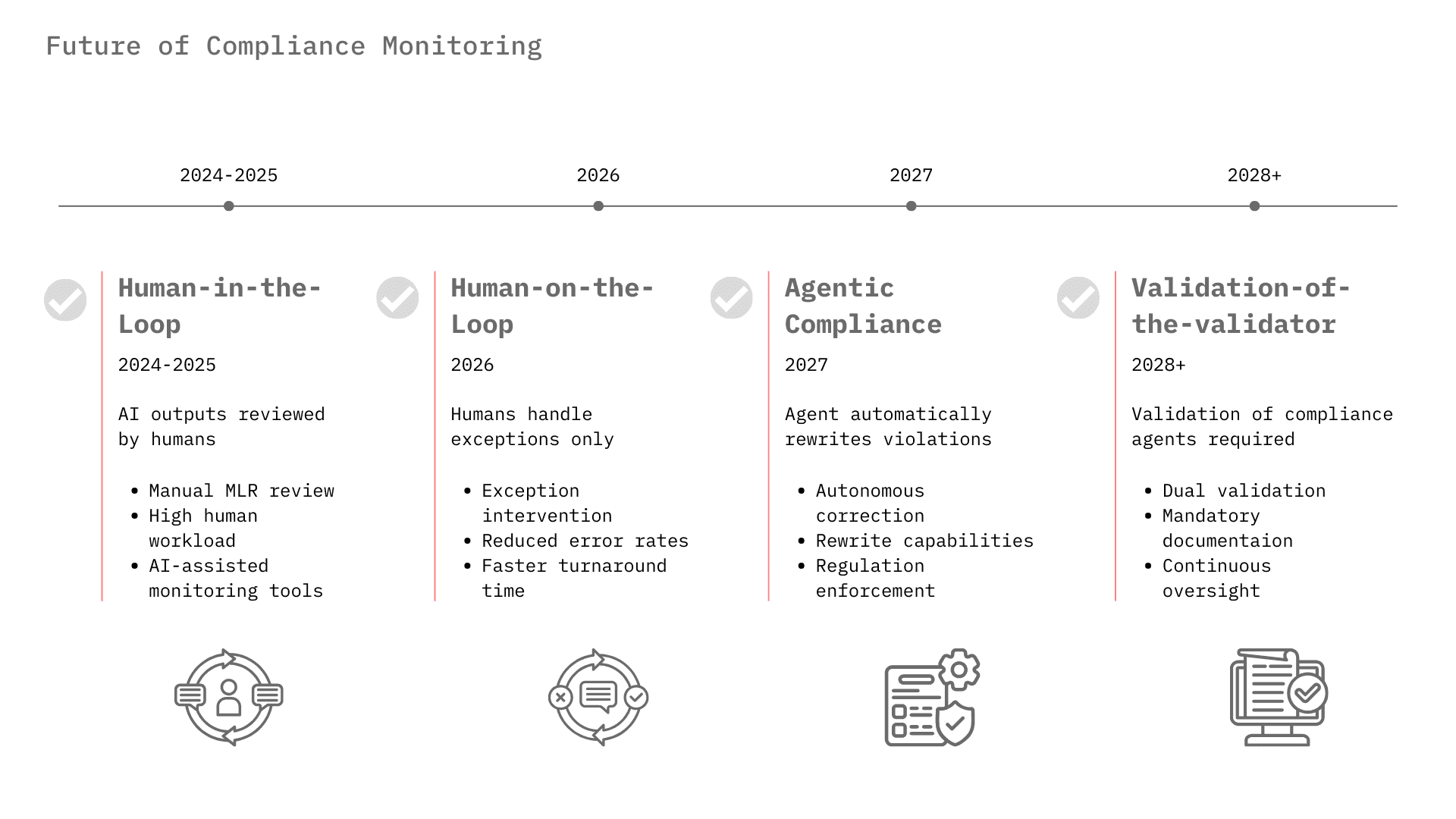
Currently, most pharma AI deployments require a human to review outputs, known as Human-in-the-Loop, due to trust issues. For example, MLR review of marketing materials is still heavily manual, though AI is beginning to pre-screen content.³² As compliance monitoring algorithms improve and demonstrate error rates lower than human reviewers, the industry will shift to Human-on-the-Loop, where the AI operates autonomously and humans manage only the exceptions flagged by the monitoring layer.
We are moving beyond passive monitoring to Agentic Compliance. In this model, a "Compliance Agent" doesn't just flag a violation; it fixes it. If a sales rep's draft email contains an off-label claim, the Compliance Agent will rewrite it to be compliant and present the revision for approval. Veeva's roadmap for "Free Text Agents" and Norm.ai's capabilities point directly to this future.¹⁰
As the EU AI Act comes into force (classifying some medical AI as "high risk") and the FDA finalizes its AI guidance, the "Compliance Monitoring" market will become a mandatory infrastructure layer, similar to cybersecurity. Companies will need to prove not just that their AI works, but that their monitoring of the AI works. This concept, "Validation of the Validator," will become a key requirement for GxP (Good Practice) compliance.
These AI monitoring challenges build on foundational compliance requirements — including audit trails, documentation integrity, and GxP standards. For the baseline framework, see our guide to clinical trial compliance and documentation best practices.
The three architectural layers covered in this report, guardrails, semantic agents, and platform-native governance are necessary components of a complete AI compliance stack. But they address the output layer. The operational layer, field conduct, patient program transactions, and regulatory change response requires a platform that monitors the whole business, not just what the chatbot says.
For a complete evaluation framework across all six compliance capabilities, regulatory intelligence, continuous monitoring, policy governance, AI copilot, purpose-built systems, and transparency reporting, see how Zelthy's compliance intelligence platform is built for pharma operations.
The market for AI output compliance monitoring in pharma is transitioning from a "nice-to-have" innovation project to a critical "license-to-operate" infrastructure. The proliferation of HCP and sales chatbots is currently throttled by compliance risks, specifically hallucination and off-label promotion.
For Sales Team Chatbots, the market is consolidating around platform-native solutions (Veeva, Salesforce) that integrate monitoring directly into the CRM workflow to enable capabilities like free-text capture. For HCP Chatbots, specifically in Medical Information, there is a vibrant market for specialized vendors (Sorcero, Eversana) that can guarantee scientific accuracy and adverse event detection.
Investors and stakeholders should prioritize technologies that offer Semantic Compliance, the ability to understand the meaning of regulations and apply them to conversation, over simple keyword filtering. The winners in this space will be those who can provide the Glass Box, which offers verifiable and audit-ready proof that the AI remained within the guardrails of the law. As pharma races to deploy the engine of Generative AI, the value of the brakes, the compliance monitoring layer, is skyrocketing.
AI output compliance monitoring is the continuous surveillance, auditing, and governance of AI-generated content in pharmaceutical operations, particularly LLM-powered chatbots and HCP-facing agents, to ensure every output meets FDA, EMA, and local regulatory requirements for truthfulness, fair balance, and adverse event reporting. It is becoming a mandatory component of the pharma commercial tech stack as generative AI bypasses traditional pre-approval review processes.
Traditional Medical-Legal-Regulatory (MLR) review governs static assets before dissemination — detail aids, print ads, email templates. AI chatbots generate probabilistic responses in real time, bypassing pre-approval containment entirely. Because each interaction can produce a novel output, MLR review cannot occur before deployment. This requires a fundamental shift from pre-approval review to real-time monitoring infrastructure.
The FDA's Office of Prescription Drug Promotion (OPDP) holds authority over all promotional communications, including AI-generated content. If an HCP chatbot fabricates a clinical result or implies efficacy in an unapproved indication, the manufacturer faces strict liability for misbranding under the FD&C Act. The FDA has committed to deploying its own AI tools to proactively surveil digital promotional content, including chatbot interactions, significantly raising the probability of detection for non-compliant outputs.
Fair balance requires that risk information be presented with equal prominence to benefit claims. In chatbot interactions, this means a system responding to an efficacy question must simultaneously surface relevant safety warnings; it cannot bury risk information in a dense paragraph or offload it to a hyperlink. The FDA's Clear, Conspicuous, and Neutral (CCN) standards require that safety information be integral to the interaction, not secondary.
Pharma AI compliance monitoring is structured in three layers: (1) Real-time guardrails — infrastructure-level tools (e.g., Lakera, NVIDIA NeMo) that block PII, prevent prompt injection, and enforce operational boundaries at the point of inference; (2) Semantic and regulatory agents — vertical specialists (e.g., Sorcero, Norm.ai) that detect off-label promotion, verify fair balance, and flag adverse events; (3) Platform-embedded compliance — CRM incumbents like Veeva and Salesforce integrating monitoring natively into commercial workflows.
Chatbot interactions with HCPs or patients inevitably surface health data, a patient mentioning a symptom following medication use constitutes a potential adverse event (AE) that must be reported within FDA-mandated timelines (15 days for serious, unexpected events). AI compliance monitoring systems must recognize AE language in unstructured chat text, classify the event, capture reporter details, and route data to pharmacovigilance databases. Manual log review is operationally infeasible at scale, making automated AE intake a core monitoring requirement.
A glass box audit trail documents not just what an AI system blocked or modified, but why, citing the specific regulatory statute or business rule that triggered the action. For example: "Response blocked because it implied efficacy in a pediatric population, contradicting Section 4.1 of the USPI." This level of explainability is required to respond to FDA inquiries or DOJ investigations, and differentiates compliant governance systems from simple content filters.

