
Patient Access Programs in APAC: PAP, PSP, CAP and DTP
September 28, 2026

Phase III trials cost $55,716 a day, so fragmentation across trial systems is a direct cost driver, not just an inconvenience. This guide lists the 10 functions a modern CTMS must centralize in 2026 (from AI-driven site selection to risk-based monitoring dashboards) to cut costs roughly 30% and pull timelines in by up to 6 months.
A modern clinical trial management system (CTMS) should centralize ten core functions: trial planning and resource management, site and investigator management, regulatory and documentation workflows (including eTMF integration), patient recruitment and enrollment tracking, budget and financial oversight, risk-based monitoring dashboards, supply chain and drug accountability, decentralized trial tool integration, data analytics and reporting, and cross-functional collaboration. Centralization matters because fragmentation across these functions is the primary driver of trial delays and cost overruns — with Phase III studies averaging $55,716 per day in direct costs (Tufts CSDD), even modest delays caused by disconnected systems represent millions in avoidable spend.
The role of CTMS has evolved from basic scheduling and tracking to serving as the central nervous system of clinical research operations — the single source of truth for sponsors, CROs, and sites across multi-study, multi-country portfolios. This guide covers the 10 functions a CTMS must centralize in 2026 and the key innovations (AI-driven site selection, risk-based monitoring, decentralized trial integration) that separate modern platforms from legacy tools.
For the foundational framework — what a CTMS is, core features, selection criteria, and comparison of leading platforms, start with our complete guide to clinical trial management systems.
Every successful trial starts with a robust planning, and a CTMS must centralize the entire process—from protocol development and site selection to resource allocation. Modern CTMS platforms now use AI-driven site selection models that analyze historical data, site capacity, and competitive landscapes that can improve enrollment by 10-20%.
Resource optimization has become critical as trial complexity increases. Studies show the average number of assessments in Phase II and Phase III trials has risen from 17 in the period from 2013 to 2016 to about 21 in the period from 2017 to 2020. A centralized CTMS helps manage staffing, equipment needs, and budget forecasting to prevent resource bottlenecks that can otherwise delay studies by months.
Site management is one of the most complex challenges in clinical trials, and a centralized CTMS provides immediate value by serving as the single repository for investigator credentials, site certifications, training records, and performance metrics across both traditional and virtual sites. Modern platforms go beyond enrollment tracking to monitor activation timelines, data quality, protocol deviations, and patient retention through real-time dashboards, enabling sponsors to quickly spot underperforming sites and take corrective action before timelines are affected.
With rising global compliance demands, centralized documentation workflows are now non-negotiable. A modern CTMS must integrate seamlessly with eTMF systems to manage submission tracking, ethics approvals, and amendment management across multiple jurisdictions. Compliance with evolving guidelines like ICH E6(R3) requires systematic documentation of risk-based strategies, making automated audit trails and monitoring critical. By centralizing regulatory reporting, tracking submission deadlines, and maintaining 21 CFR Part 11–compliant records, CTMS platforms help sponsors ensure efficiency, accuracy, and inspection readiness.
Patient recruitment continues to be the biggest cause of trial delays, particularly as precision medicine and biomarker-defined subpopulations, which are now important to more than half of oncology trials, reduce eligible patient pools. A modern CTMS must consolidate recruitment methods, screening workflows, and enrollment projections across several sites, as well as integrate with EHRs and patient-matching systems to automatically discover candidates. With decentralized models on the increase, platforms should also handle eConsent, remote enrollment, and real-time tracking of funnel metrics, conversion rates, and screen failures in order to constantly improve recruitment efforts.
Clinical trial expenses continue to skyrocket, with a 2016 Tufts study putting the overall cost of bringing a new medication to market at $2.6 billion and phase III trials costing $255 million. Moore et al.'s (BMJ, 2022) more recent investigation revealed lower numbers, with an average per-patient cost of $41,413 and a median pivotal trial cost of $48 million (IQR $20–102 million). While estimates vary, there is no denying that clinical trial costs are significant. In this context, CTMS platforms must consolidate site payments, milestone tracking, and budget variance analysis across several worldwide sites with different currencies and terms. Modern CTMS solutions facilitate proactive cost control, audit-ready financial oversight, and a higher return on trial investments by integrating with procurement systems to capture vendor payments, site fees, and product costs, as well as providing real-time dashboards for budget burn rates and cost-per-patient metrics.
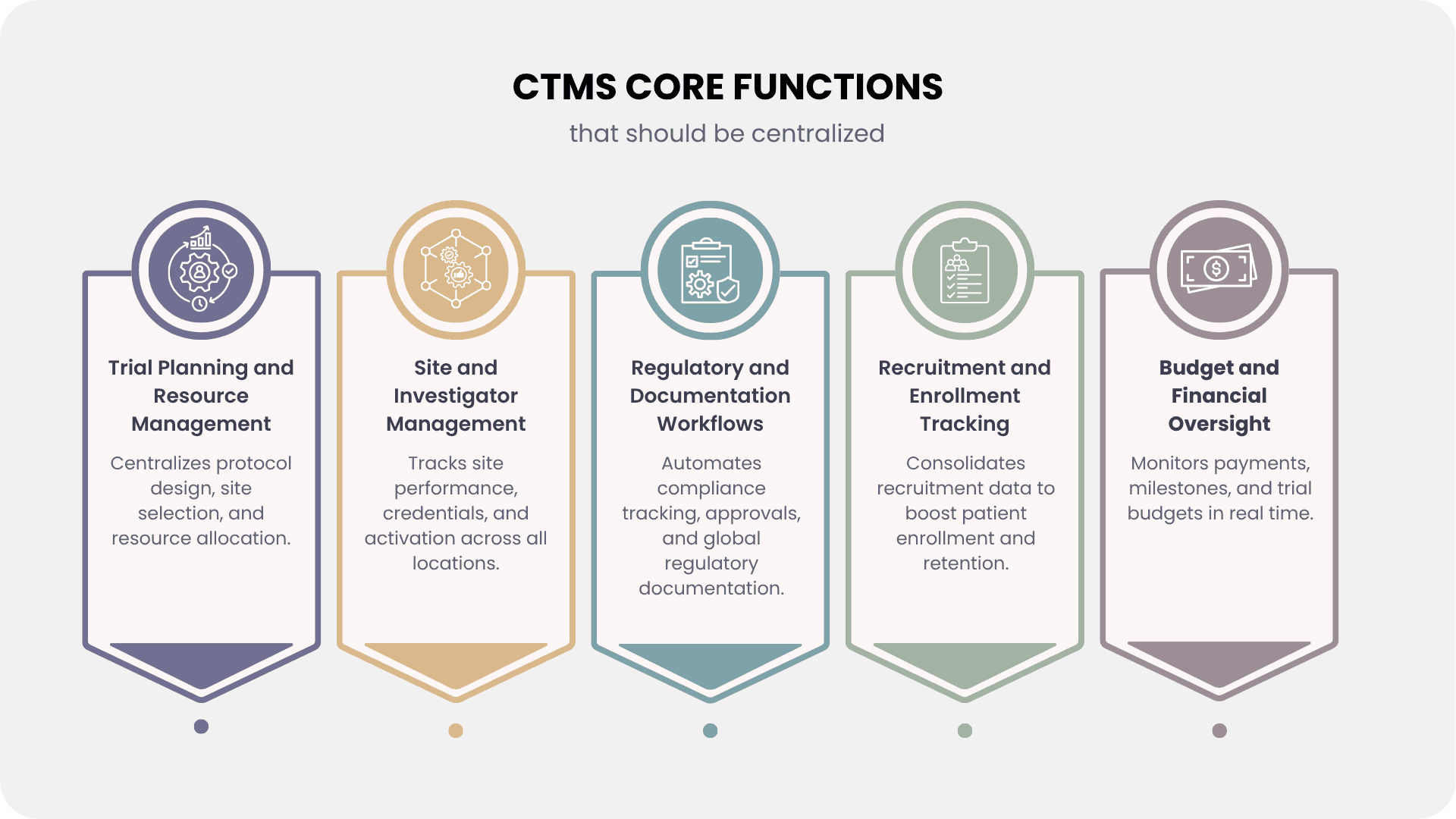
A modern CTMS must centralize five foundational functions:
Beyond these, leading platforms also centralize risk-based monitoring, decentralized trial integration, real-world evidence workflows, AI analytics, and data privacy compliance.
With decentralized clinical trials growing over 400% between 2012 and 2022 (GlobalData), CTMS platforms must now connect seamlessly to ePRO systems, wearables, telehealth, and home health services. Beyond data integration, the goal is to orchestrate hybrid and virtual workflows—managing direct-to-patient shipments, remote visits, and digital biomarker collection—while ensuring engagement, compliance, and data integrity.
For advanced therapies where trial operations intersect with manufacturing and logistics, Zelthy's advanced therapy orchestration platform connects treatment centres, couriers, and coordinators alongside trial management workflows.
Since 2017, the FDA has approved multiple drugs based on real-world evidence (RWE), making RWE integration a CTMS imperative. Using standards like HL7 FHIR, platforms must link EHRs, registries, and trial systems to enable post-market surveillance and comparative effectiveness studies. Centralizing RWE study designs, protocols, and analysis ensures trials align with evolving regulatory expectations.
RBM has shifted from recommendation to necessity under ICH E6(R3). CTMS platforms must provide centralized dashboards with predictive analytics, anomaly detection, and resource allocation tools. This approach improves data quality, strengthens patient safety oversight, and can reduce monitoring costs by up to 30% through targeted interventions.
AI is now a core enabler of faster trials, with leading biopharma companies reporting six-month timeline reductions. CTMS platforms must centralize AI for enrollment prediction, site performance forecasting, and protocol optimization. Machine learning and NLP can forecast risks, extract insights from reports and communications, and support real-time decision-making across the trial lifecycle.
Global regulations like GDPR, HIPAA, and state privacy laws make centralized compliance workflows essential. Modern CTMS must manage consent, cross-border transfers, and subject rights, while enforcing advanced encryption, role-based access, and full audit trails. Failure to comply can result in fines of €20 million or 4% of global turnover, making data security a strategic as well as regulatory priority.
Modern clinical trials demand a system that unifies operations, compliance, and oversight into one platform. Zelthy CTMS is designed to address exactly these needs, helping sponsors and CROs achieve efficiency while staying regulatory-ready.
By consolidating these functions, Zelthy allows trial teams to focus on science and patient outcomes rather than administrative overhead—making it a modern alternative to bulky, generic CTMS platforms. Check out the complete guide on CTMS.
Ready to transform your clinical trial management? Connect with our team to see how Zelthy can power your next clinical trial. For further inquiries, feel free to reach out to us at connect@zelthy.com or on LinkedIn.
Phase III trials cost an average of $55,716 per day in direct costs. Fragmentation across planning, site management, and compliance documentation is the primary driver of avoidable delays. Centralizing these functions in a single CTMS eliminates the manual handoffs, data reconciliation, and communication gaps between disconnected systems that accumulate into weeks or months of lost trial time.
Risk-based monitoring (RBM) is an FDA- and EMA-endorsed approach that focuses oversight resources on the sites and processes with the highest probability and impact of errors, rather than applying uniform monitoring across all sites. ICH E6(R3) has elevated RBM from a recommendation to a requirement. CTMS platforms must provide centralized RBM dashboards with predictive analytics and anomaly detection to support this approach, platforms that lack native RBM capabilities force manual workarounds that defeat the cost savings RBM is designed to deliver.
A CTMS must integrate with ePRO systems, wearables, telehealth platforms, and home health services to support decentralized trials, which grew over 400% between 2012 and 2022. Beyond data integration, the CTMS should orchestrate direct-to-patient shipment logistics, remote consent workflows, and virtual visit scheduling. Without centralized DCT support, sponsors managing hybrid trials face data gaps between site and remote patient data that compromise data integrity and regulatory submissions.
An electronic Trial Master File (eTMF) is the complete collection of documents that demonstrates regulatory compliance across a trial's lifecycle, from protocol approval through close-out. A CTMS must integrate with eTMF systems to automate document version control, track submission deadlines, and maintain 21 CFR Part 11–compliant audit trails across multiple jurisdictions. Disconnected eTMF management creates inspection risk and is one of the most common findings in FDA and EMA site audits.
AI-driven site selection models analyze historical site performance data, investigator track records, patient population density, and competitive trial landscapes to identify sites most likely to enroll patients quickly and maintain protocol compliance. McKinsey data cited in trials research indicates these models can improve enrollment rates by 10–20% compared to manual site selection methods, meaningful gains given that patient recruitment failures account for the majority of clinical trial delays.
A CTMS should centralize site payments, milestone-based invoicing, budget variance tracking, and cost-per-patient metrics across all trial sites and currencies in real time. Integration with procurement and ERP systems captures vendor payments, site fees, and drug supply costs. Real-time dashboards for budget burn rates allow sponsors to identify overspend early, critical given that per-patient trial costs average $41,413 and median pivotal trial costs exceed $48 million.

